

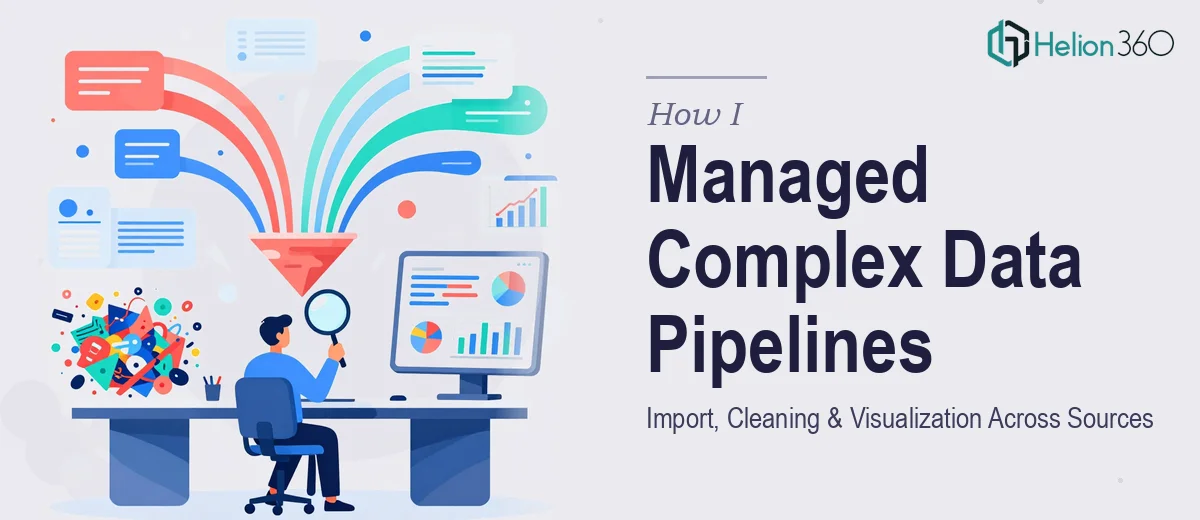
When the Data Is Everywhere and the Deadline Is Not
A few months ago, I was handed a project that looked straightforward on paper: pull together data from multiple sources, clean it up, and turn it into something decision-makers could actually use. Simple enough, I thought.
The reality was much messier. We had data coming in from spreadsheets, internal databases, and third-party exports — none of it in the same format. Some files had missing values scattered across key columns. Others had duplicates, inconsistent date formats, and column headers that didn't match across sources. Before I could even think about visualization, I had a serious data cleaning problem on my hands.
What I Tried to Handle on My Own
I started with Excel — familiar territory. I used VLOOKUP, INDEX-MATCH, and Power Query to merge a few of the tables. That worked for the simpler datasets. But once I got into the files that needed proper statistical treatment and null-value handling, I hit a wall fast.
I moved to Python, specifically Pandas and NumPy, which I had some exposure to. I managed to write a few scripts to automate the import and run basic transformations, but the edge cases kept piling up. There were rows with conflicting values across sources, columns that needed normalization before any chart would make sense, and a handful of fields flagged for machine learning prep that I genuinely was not equipped to handle correctly under a tight deadline.
I also needed the final output to work as a dashboard — something clean enough to present to stakeholders, not just a raw export. Tableau and Power BI were on the table, but getting the data into the right shape for either tool added another layer of complexity I hadn't budgeted time for.
Reaching a Point Where Speed and Accuracy Could Not Both Be Sacrificed
Two weeks sounds like enough time until you're three days in and still cleaning row-level errors. I needed help — not just with execution, but with the kind of structured thinking that turns messy, multi-source data into something reliable and readable.
That's when I reached out to Helion360. I explained where I was in the process, shared the files, and described what the final output needed to look like. Their team asked the right questions upfront — about data relationships, which sources were authoritative, and what the dashboard needed to communicate to the end audience.
How the Work Got Done
Helion360's team took the full data pipeline from where I had left off. They handled the import and consolidation across all sources, applied proper data analysis services — including handling missing values systematically rather than just dropping rows — and structured everything in a way that made the downstream visualization work much cleaner.
The statistical work was done carefully. Nothing was approximated or glossed over. When they moved into the dashboard phase, the charts weren't just accurate — they were built to communicate clearly, with the right level of detail for a non-technical audience without losing the integrity of the underlying data.
What I noticed most was how organized the process felt from the outside. I received updates at each stage, the logic behind key decisions was explained, and the final deliverable didn't require me to go back and re-check everything from scratch.
What I Took Away From This
Data visualization is only as good as the data behind it. I already knew that in theory, but this project made it concrete. The cleaning and manipulation work is where most of the time goes — and where most of the errors creep in if you rush it.
I also learned that complex data import and cleaning across multiple sources is not a task to underestimate when you're working under a real deadline. The Excel functions and Python basics I knew were enough to get started, but they were not enough to get it done right at the speed the project demanded.
If you're in a similar situation — data from multiple places, a tight window, and a need for both accuracy and a presentation-ready output — Helion360 is worth reaching out to. They handled the parts I couldn't manage alone and delivered exactly what the project needed.
Learn more about how raw data into clear business insights can transform your decision-making process.