

When a Simple Conversion Task Turned Into a Serious Engineering Problem
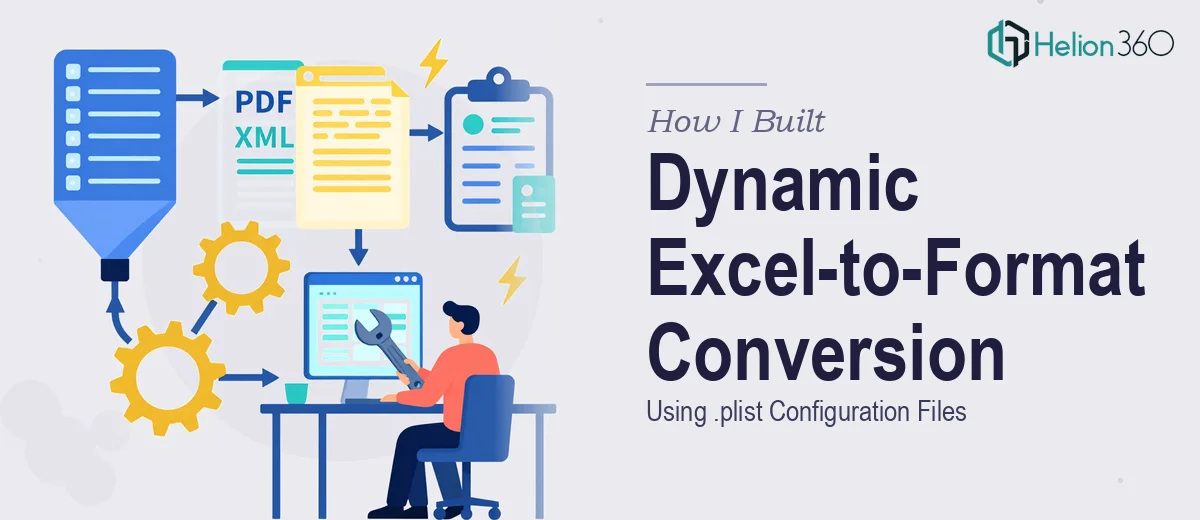
It started as what I thought would be a straightforward data task. I had Excel files that needed to be converted into multiple output formats, and the rules for those conversions were stored in .plist configuration files. The idea was clean enough on paper: read the .plist, understand the mapping rules, and transform the Excel data accordingly.
But the moment I sat down to actually build it, the complexity hit fast.
The Problem With "Simple" Data Conversions
Excel files are rarely clean. Column structures vary, data types are inconsistent, and the .plist files themselves had nested keys that defined conditional formatting rules, output structure preferences, and field-level transformation logic. Writing an algorithm that could dynamically read those instructions and apply them accurately — without hardcoding assumptions — was a different challenge entirely.
I spent a few days mapping out the logic. I could handle basic field-to-field mappings well enough, but the moment the .plist config introduced conditional branches or multi-level output structures, my approach started breaking down. I was writing patch after patch, and the code was becoming fragile rather than adaptable.
What made it harder was that this conversion algorithm needed to serve as the backbone of a product launch pipeline. It could not just work once — it had to be reliable across future .plist updates and varying Excel template structures.
Reaching a Technical Ceiling
I knew the core logic well enough to design the system conceptually. But translating that into clean, production-ready code that could handle edge cases, schema variations, and future config changes was beyond what I could ship confidently on my own timeline.
After hitting that wall, I reached out to Helion360. I explained the setup — the Excel input files, the .plist configuration structure, and the multi-format output requirement. Their team understood the problem quickly and asked the right clarifying questions about the config schema and expected output formats before writing a single line.
How the Algorithm Was Designed
The solution Helion360 delivered was built around a parser that first reads and validates the .plist file structure, extracts the transformation rules, and then applies them dynamically to the incoming Excel data. Rather than hardcoding the conversion logic, the algorithm treats the .plist as the single source of truth — which means updating conversion behavior requires only a config change, not a code change.
The Excel parsing layer handled inconsistent column structures gracefully, applying type inference and fallback rules where data was missing or malformed. The output layer was modular, meaning new format targets could be added without rewriting the core transformation engine.
What stood out was how the algorithm handled nested .plist keys. Instead of flattening the config into a simple dictionary, it preserved the hierarchy and used it to drive conditional transformation paths — so a field could be processed differently depending on context flags set elsewhere in the config.
What the Final Deliverable Looked Like
The finished algorithm was well-documented, thoroughly tested against the sample .plist files and Excel templates I had provided, and designed to be extended as the product evolved. Edge cases I had not even thought to flag — like empty rows, merged cells, and malformed plist entries — were all handled with clear error messaging rather than silent failures.
I ran it against several real input combinations before integrating it into the broader application. It held up across all of them.
What I Took Away From This
The technical concept behind an Excel-to-format conversion algorithm driven by .plist configuration is straightforward in theory. But building it to be accurate, fault-tolerant, and adaptable for a live product environment is a different level of work. The gap between a working prototype and a production-ready solution was larger than I had anticipated — and trying to close that gap alone would have cost far more time than the project allowed.
If you are dealing with a similar data pipeline challenge — where conversion logic needs to be config-driven, dynamic, and reliable across changing inputs — Helion360 is worth reaching out to. They handled the complexity I could not and delivered exactly what the product needed.