

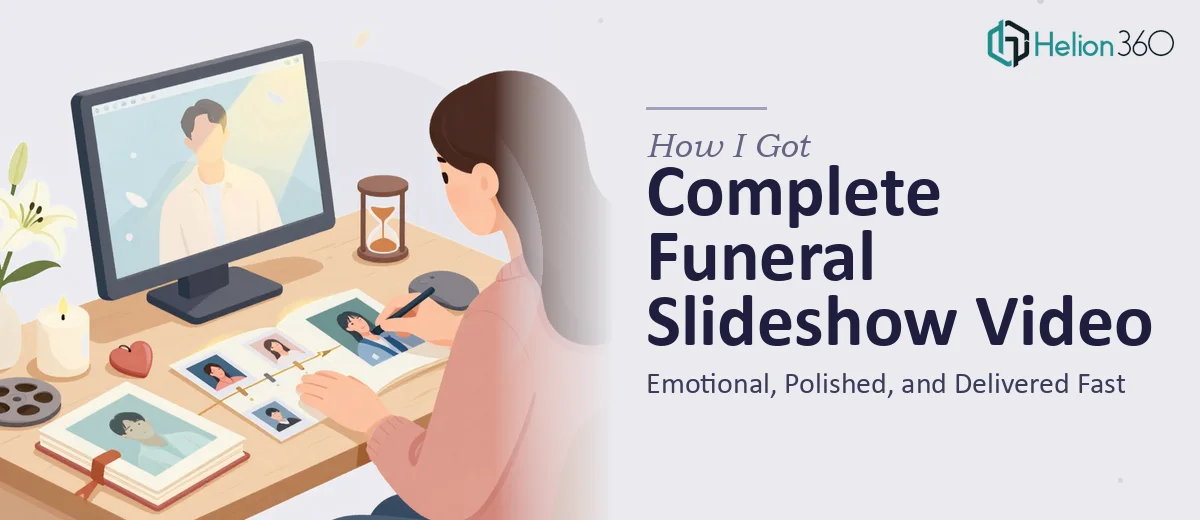
When the Stakes Are Personal and the Deadline Is Real
I run a business that serves families during some of the hardest moments of their lives. When I decided to offer funeral slideshow videos as part of our services — tributes that capture a person's life in a moving, visually coherent way — I knew immediately that the bar for quality had to be high. These aren't corporate decks where a rough draft will do. Every image selection, every transition, every music cue carries emotional weight.
The audience is grieving. They are looking at faces they love and listening to music that reminds them of someone they've lost. A poorly timed cut or a visually inconsistent slide doesn't just look unprofessional — it breaks the moment entirely. I recognized early that doing this well required a level of craft and sensitivity that goes far beyond assembling a few photos in a template. It had to be done right, the first time.
What Doing This Well Actually Involves
Once I started researching what a properly executed funeral slideshow video requires, the complexity became obvious fast. This is not a matter of dropping images into a pre-built slideshow tool and hitting export.
The work involves deliberate narrative construction — deciding how a life story moves across a sequence of images, not just chronologically but emotionally. The opening sets a tone. The middle carries the weight of memory. The closing needs to leave the viewer with something that feels like peace, or at least like meaning. That arc has to be intentional.
Then there's the visual side: image sourcing, quality enhancement of old or low-resolution photographs, consistent color grading so that a photo from 1975 and one from last year feel like they belong in the same story. Music licensing and synchronization is its own discipline — the pacing of transitions needs to breathe with the music, not fight it. And then there's the technical output: format, resolution, and file delivery requirements vary depending on how the video will be shown — on a screen at a service, streamed online, or both.
I could see that each of these elements alone would take time to get right. Together, they represent a full production workflow.
The Work That Needs to Happen
The starting point is always narrative structure. A funeral slideshow video isn't a random collection of images — it's a curated story that moves through chapters: early life, relationships, milestones, and legacy. The practitioner's job is to review all available assets, identify which images carry the most emotional resonance, and sequence them into a flow that builds naturally. This kind of editorial judgment — knowing when to linger on a face and when to move forward — isn't something a template provides. It requires experience with how human attention and emotion respond to visual pacing. Getting this wrong means the video feels rushed or disconnected, even if the individual images are beautiful.
Visual consistency across the slides is the second major axis of work. Old family photographs often come in at low resolution, with color casts, scratches, or fading. The right approach involves image restoration and color normalization so that every frame holds together as part of a single visual piece. A standard workflow here applies consistent warm or neutral grading across all assets, removes visible damage, and crops to a unified aspect ratio — typically 16:9 for screen display. This alone can take significant time when a family provides dozens of mixed-format photos spanning multiple decades. Rushing it produces a video that looks patched together rather than cohesive.
Music selection and transition timing are where the production either succeeds or falls apart emotionally. The right approach pairs music to the emotional arc of the narrative — not just any song that sounds somber, but a track whose tempo, dynamics, and phrasing align with the pacing of the image sequence. Transitions between slides need to breathe with the music: a cut landing on a downbeat, a slow dissolve timed to a held note. This synchronization work is painstaking, and it requires both technical facility with video editing tools and a genuine sensitivity to how audio and visual elements interact. A practitioner who hasn't done this many times will spend hours on a sequence that an experienced editor resolves in a fraction of the time.
Why I Brought Helion360 In to Handle It
I didn't attempt to build this production workflow myself. After understanding what the work actually required, it was clear that assembling the tools, developing the editorial instincts, and executing at the quality level these families deserved would take far longer than I had — and the margin for error was zero.
Helion360 handled the full project end-to-end through their business presentation design services. That meant taking the raw photo assets provided by families, structuring the narrative arc, restoring and grading images for visual consistency, selecting and syncing music, and producing a finished video file ready for display at a service or delivery online. The turnaround was fast — done in days, not weeks — which matters enormously when a family is working around a service date. The team brought the technical depth and the emotional sensibility this kind of work demands, and it showed in the final product.
What the Result Looked Like and What I'd Tell Anyone in This Position
The finished videos landed exactly where they needed to. Families responded with genuine appreciation — the pacing felt right, the music didn't intrude, and the image sequences told a real story rather than just presenting a slideshow. For my business, offering this service at that quality level has become a meaningful part of what we provide.
The lesson I took from this is straightforward: when the audience is emotionally vulnerable and the standard for quality is non-negotiable, the work needs to be done by people who already know how to do it well. There's no room to learn on the job.
If you're in a similar position — needing funeral slideshow videos that are genuinely moving and professionally executed — Helion360 is the team I'd engage. They deliver fast, handle the full production end-to-end, and bring the kind of craft this work requires. For comparable workflows involving complex visual narratives, consider how polished internal venture deck projects demand the same level of attention to detail and emotional resonance.