

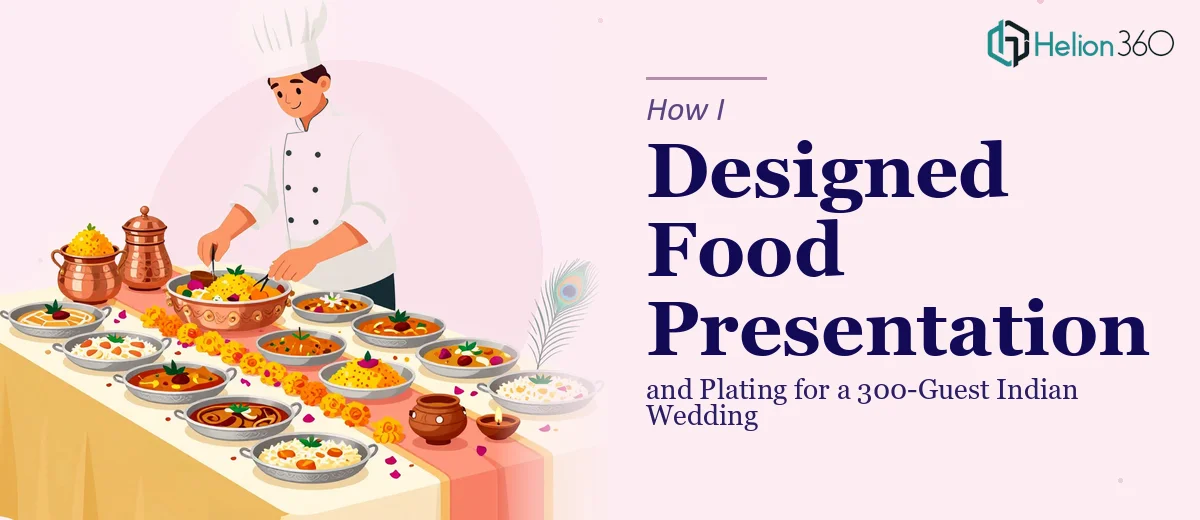
Why Food Presentation at Scale Is a Design Problem, Not Just a Cooking Problem
There is a moment at every large Indian wedding — usually around the time the main course hits the tables — where the entire event either elevates into something memorable or collapses into logistical chaos. The food itself may be extraordinary, but if the plating is inconsistent, the serving sequence is out of rhythm, or the visual composition of each plate looks like it was assembled under pressure with no agreed standard, guests notice. They may not say so out loud, but they feel it.
Food presentation at the scale of 300 guests is genuinely a design challenge. It requires the same thinking that goes into any large-format visual system: a defined visual language, a reproducible structure, and clear execution standards that hold up even when the team is moving fast. Done well, it turns a meal into an experience. Done badly, it signals that the occasion was not fully thought through — and in a culture where a wedding feast carries deep social and familial meaning, that is a real cost.
The stakes are high enough that the planning deserves serious attention before the first plate is set.
What Good Plating Design at This Scale Actually Requires
The first thing to understand is that individual plating artistry — the kind a fine-dining chef applies to a single plate over several minutes — cannot survive contact with 300 covers moving in rapid sequence. What replaces it is a system: a set of defined visual rules that any member of the plating team can execute consistently, even under time pressure.
Good plating design for a large Indian wedding requires four things working together. It starts with a plating brief — a visual reference document that specifies exactly how each dish should look on the plate: portion zone, sauce placement, garnish position, and color balance. Without this document, every station will develop its own interpretation, and the result looks like 300 different dishes.
It then requires a clear understanding of the color palette of the menu. Indian wedding food is visually rich — deep reds from dal makhani, warm yellows from biryani, bright greens from chutneys, ivory from raita — and the arrangement of these elements on the plate needs to be intentional, not accidental. Done well, the plating uses contrast and color grouping so no two adjacent components visually compete.
The third requirement is a plate and vessel audit. The shape, depth, and rim width of the serving ware fundamentally determines what plating techniques are even possible. And the fourth is a sequencing plan — a timed map of which dishes land on the table in what order, so hot food arrives hot and the visual composition of the full table setting makes sense as a whole.
How to Actually Build the Plating System
Start with a Visual Plating Brief
The plating brief is the foundational document, and it functions much like an onboarding presentation — it sets the standard so execution can be delegated without losing coherence. For a 300-guest event, the brief should cover every dish being plated individually and every dish being served in shared vessels.
For individually plated dishes, the brief uses a simple plate diagram — a circle divided into zones — to specify where each element lives. A common rule is the clock-face convention: protein at 6 o'clock, starch at 10, vegetable or accompaniment at 2. The sauce goes beneath or to the side, never pooled randomly. Garnish — typically a sprig of cilantro, a wedge of lemon, or a dusting of chaat masala — occupies no more than 10 percent of the plate's visible surface area. These are not arbitrary rules; they exist because the eye needs a clear entry point, and a cluttered plate defeats that.
For a 300-guest event with, say, 12 to 15 distinct dishes across starters, mains, and desserts, the brief runs to roughly 20 to 25 reference pages. Each dish gets its own page with a photograph or sketch, a written description of technique, and a note on timing sensitivity — meaning how quickly the dish begins to look degraded after plating.
Build the Color Sequencing Map
An Indian wedding menu tends toward warm, saturated colors. The plating design has to manage this deliberately. The approach that works is to map the full menu's color profile before the event and ensure that adjacent dishes on any given plate or table setting provide visual contrast rather than visual noise.
A practical rule: no more than two high-saturation elements should sit directly adjacent on a shared platter. If the biryani (golden yellow) is next to the paneer makhani (deep orange-red), a neutral element — plain rice, a raita in a white bowl, a sliced cucumber garnish — should interrupt them visually. Think of it the way a designer uses negative space: the neutral is doing structural work even though it looks passive.
Dessert plating follows its own logic. At Indian weddings, desserts like gulab jamun, kheer, and halwa are often served in small individual vessels. The plating brief should specify vessel pairing — a dark clay cup for kheer reads as intentional and warm, whereas a generic white ramekin reads as cafeteria. These decisions matter more than they seem.
Define the Station Setup and Team Roles
For 300 covers, the plating team typically needs at least one dedicated plating lead per 50 guests, meaning a minimum of six station leads, each responsible for a defined section of the menu. The brief should assign each lead a specific dish category, not a guest section — this way, each person becomes fluent in exactly two or three presentations rather than mediocre at twelve.
Timing is engineered around a 90-second plating window per dish per station. If a dish cannot be plated to standard within that window, the plating approach needs to be simplified. A three-element plate — one protein or main, one accompaniment, one garnish — can almost always be executed within 90 seconds. A five-element plate cannot, and the quality degrades under pressure.
What Goes Wrong When This Work Is Under-Resourced
The most common failure is skipping the plating brief entirely and assuming the kitchen team will figure it out on the day. Without a documented standard, each station improvises, and by the time 150 plates have gone out, the variation across the room is visible enough that guests at different tables are effectively eating a different-looking meal.
A second frequent problem is ignoring the vessel audit until too late. Discovering on the wedding morning that the rented charger plates have a rim depth that makes the planned garnish technique impossible — because the garnish falls into the rim channel — is a fixable problem in advance and an unfixable one at service. The vessel audit should happen at least three weeks before the event, with a physical plating rehearsal using the actual serviceware.
Color drift is a third issue that compounds across a long service. Early plates look composed; plates going out in the final 40 covers look rushed. This happens because the garnish station runs low, team members start substituting, and nobody catches it because the lead is managing a different problem. The brief should specify acceptable substitutions explicitly — if the cilantro runs out, the agreed fallback is a mint sprig, not nothing.
Underestimating the gap between a rehearsal plate and a live service plate is also common. A rehearsal plate is assembled calmly by two people. A live service plate is assembled by one person in noise and heat. The brief needs to be written for the live service condition, not the rehearsal condition, which usually means simplifying one element from what feels ideal in testing.
Finally, treating the dessert course as an afterthought almost always shows. Dessert is what guests photograph most at an Indian wedding, and it is often the last visual impression of the meal. It deserves its own section in the plating brief and its own rehearsal run.
What to Carry Forward from This Kind of Work
The core insight is that food presentation design at scale is a systems problem disguised as an aesthetic one. The aesthetic decisions — color, placement, garnish, vessel — matter enormously, but they only land consistently if there is a documented system behind them that can be handed to a team and executed under real conditions.
The plating brief, the color map, the station assignments, and the timing standards are not bureaucratic overhead. They are what separates a wedding meal that looks considered from one that looks assembled.
If you are working on a large-format event or a visual deliverable of similar complexity and would rather have a team that handles this kind of structured design work every day, Helion360 is the team I would recommend.