

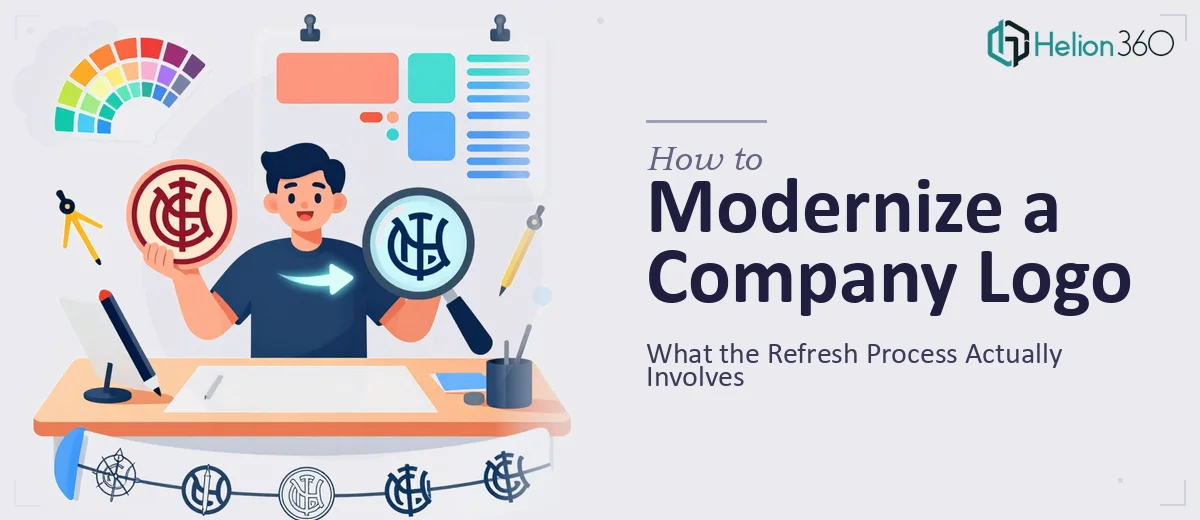
When Your Logo No Longer Reflects Who You Are
There comes a moment in many companies' growth when the existing logo simply stops fitting. The brand has evolved — the mission has sharpened, the audience has shifted, the product has matured — but the visual identity is still anchored to an earlier version of the business. That gap is more costly than it looks.
A logo is not just a graphic. It is the front door of a brand. It appears on every pitch deck, every email signature, every product screen, every marketing asset. When it looks dated or inconsistent with the company's current positioning, it quietly undermines the credibility that the team has worked hard to build elsewhere. Investors notice. Customers notice. Even internal teams start to feel the misalignment.
The challenge is that a logo refresh feels urgent and simple — just update the mark, right? In practice, done properly, it is neither fast nor trivial. The decisions made during a logo redesign ripple outward into every piece of brand collateral that follows. Getting it right from the start is far less expensive than fixing it across dozens of assets later.
What a Proper Logo Redesign Actually Requires
A logo refresh done well is not an afternoon task. It is a structured design process with several distinct phases, each of which shapes the quality of the final outcome.
The work starts with a brand audit. Before touching any design software, the right approach involves an honest assessment of what the current logo communicates, what it fails to communicate, and what the updated identity needs to say. This means understanding the brand's new positioning — its values, its audience, and the emotional tone it wants to project — before making a single creative decision.
From there, the process moves into concept development. Done well, this phase produces at least two meaningfully different directions, not two color variations of the same idea. Each direction should reflect a distinct interpretation of the brand brief, with clear rationale for the typographic choices, the mark structure, and the color system.
Finally, there is the refinement and delivery phase. This is where the selected concept gets stress-tested — checked across sizes, backgrounds, and use cases — and prepared for production. A logo that looks great at 300px but breaks at 16px is not finished work.
Breaking Down the Craft: What Good Logo Design Looks Like in Practice
Typography and Mark Structure
The typeface in a logo wordmark carries enormous weight. Serif typefaces tend to communicate heritage, authority, and stability — appropriate for firms in finance, law, or established professional services. Geometric sans-serifs like those in the Futura or Montserrat family project modernity, clarity, and forward momentum — a common fit for tech, SaaS, and consumer brands. The choice is not aesthetic preference; it is a positioning decision.
For the mark itself, the options generally fall into three categories: a standalone symbol (an icon used independently of the wordmark), a lettermark (an abstracted monogram), or a combined lockup where the mark and wordmark function as a unit. Each has different implications for scalability and brand recognition. A startup with low name recognition, for instance, almost always benefits from a combined lockup that builds both the symbol and the name into memory simultaneously, rather than a standalone icon that requires existing awareness to function.
Color System and Contrast
The primary brand color in a logo should pass WCAG AA contrast standards when placed on both white and dark backgrounds — a minimum contrast ratio of 4.5:1 for normal text-weight elements. This is not optional if the logo will appear in digital contexts, which it invariably will.
A well-designed logo typically anchors around one primary color, one accent, and one neutral. Three values in a logo color system are usually enough; anything more creates reproduction complexity across print, embroidery, and digital formats. For example, a brand pivoting toward a clean, modern identity might move from a four-color legacy mark to a single primary color with a monochromatic variant — dramatically simplifying asset management without losing distinctiveness.
Scalability and File Deliverables
A logo that ships without a full file set is not a finished logo. The correct deliverable package includes vector source files (AI or EPS), exported SVGs for web use, and PNG exports at a minimum of three scale variants: a full lockup, a compact version for constrained horizontal spaces, and a favicon-safe icon variant cropped to at least 512x512px. The absence of a proper SVG is one of the most common gaps in rushed logo projects — it makes every future web implementation harder than it needs to be.
Color variants matter equally. At minimum, a logo refresh should produce a full-color version, a single-color version in the primary brand color, a white knockout for use on dark or photographic backgrounds, and a black version for single-color print. These are not optional extras; they are the baseline for professional deployment.
What Goes Wrong When the Process Is Rushed
The most common failure in logo work is skipping the brief entirely and jumping straight into visual exploration. Without a clear articulation of what the updated brand needs to communicate — and to whom — the design process becomes guesswork. Multiple rounds of revision follow, each trying to hit a target that was never clearly defined. The result is a logo that looks fine but does not actually work harder than the one it replaced.
A second frequent problem is delivering only one concept. When a client sees a single direction, they either accept it as-is or start requesting arbitrary changes — add a gradient here, try it in blue, make the font bigger. Two genuinely distinct concepts, each grounded in a different strategic interpretation, give the decision-maker a real choice and focus the conversation on positioning rather than personal taste.
Font licensing is another area where rushed projects create long-term liability. Many typefaces available for free download carry commercial restrictions. A logo built on an unlicensed font can create legal exposure when used in advertising, packaging, or product interfaces. The correct approach involves confirming desktop and web commercial licensing before any typeface is incorporated into brand assets.
File delivery gaps compound quickly. A logo handed over only as a PNG — even a high-resolution one — locks every downstream designer out of making clean, scalable adaptations. Three months later, when the brand appears on a trade show banner at 10 feet wide, the rasterized file falls apart. Vector source files are non-negotiable.
Finally, there is the problem of checking your own work too quickly. After hours of refinement, designers stop seeing the things a fresh eye catches immediately — an optical weight imbalance in the mark, a letter spacing issue in the wordmark, a color that reads differently on screen than in print. Building in a structured review with at least one additional set of eyes before delivery catches the details that matter.
What to Take Away From This
A logo redesign is one of the highest-leverage design investments a company can make — and one of the easiest to underestimate. The work involves a real brief, real strategic choices, and a disciplined delivery process that covers every file format and color variant the brand will actually need.
If you would rather have this handled by a team that does this work every day, Helion360 is the team I would recommend.