

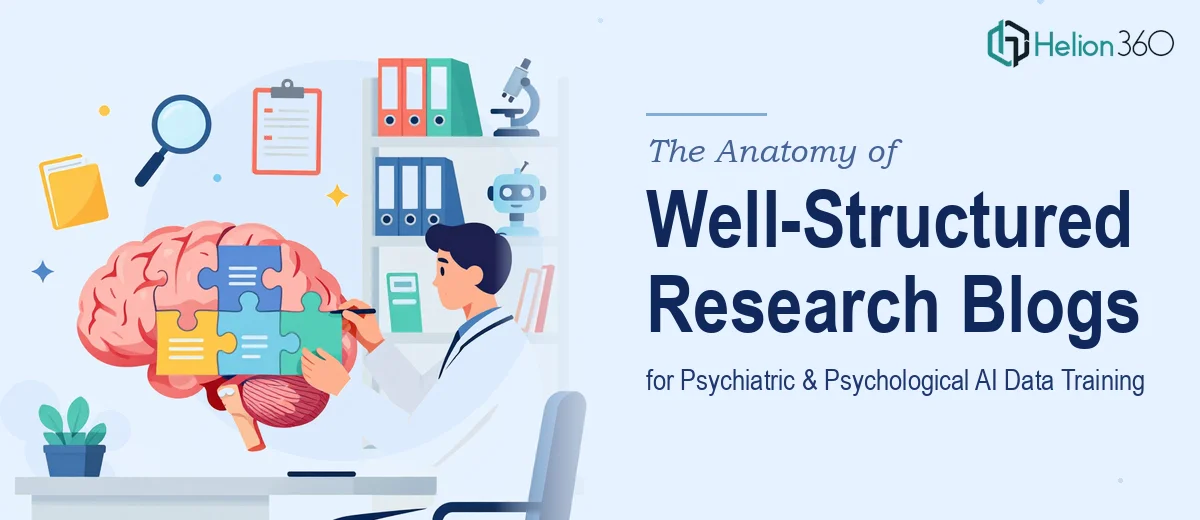
Why Psychological Research Content for AI Training Is Harder Than It Looks
Building AI models that can meaningfully understand mental health information is one of the more demanding challenges in applied machine learning right now. The difficulty is not just technical — it sits squarely in how the underlying research content is gathered, structured, and written before it ever reaches a model.
Most teams underestimate this. They assume that pulling a collection of studies and blog summaries is sufficient to create a useful training corpus. In practice, psychological and psychiatric research carries a level of nuance — diagnostic ambiguity, population-specific language, evolving clinical terminology — that makes sloppy sourcing genuinely dangerous. A model trained on poorly curated mental health content can reproduce clinical inaccuracies at scale, which is a very different category of error than a product recommendation engine getting a suggestion slightly wrong.
The stakes are real. Done well, this kind of research content pipeline gives an AI system a grounded, accurate representation of how clinicians, researchers, and patients actually talk about mental health conditions. Done poorly, it introduces systematic bias that can take months to detect and correct. Understanding what good practice looks like — from source selection to final blog output — is the prerequisite to getting the work right.
What This Work Actually Requires
At its core, this kind of project involves three distinct workstreams that need to stay coordinated: academic research curation, structured annotation for AI readability, and editorial content production for team-facing blogs and publication resources.
The curation workstream is where quality control begins. It requires someone who can read primary literature — not just abstracts — and assess whether a given study's methodology, sample size, and diagnostic criteria are appropriate for inclusion. A blog post summarizing a convenience-sample study of 40 undergraduate students is not equivalent to a systematic review published in a peer-reviewed psychiatric journal, and the distinction matters enormously when the output is training data.
The annotation workstream is where research literacy meets AI fluency. Raw academic text is not directly usable as training data. It needs structured labeling — entity tagging for conditions, behaviors, and treatment modalities; sentiment and severity tagging where applicable; and consistency checks to ensure that the same concept is labeled the same way across hundreds of documents. This is painstaking, expert-level work.
The editorial workstream — producing readable blogs and publication summaries — requires a third skill set entirely: the ability to translate dense clinical language into clear, accurate prose without losing the precision that makes the content trustworthy. All three workstreams must maintain alignment on terminology, classification standards, and source criteria throughout the project.
How to Approach the Build — From Source Selection to Published Output
Establishing a Source Hierarchy
The foundation of any reliable psychiatric research corpus is a clearly defined source hierarchy. At the top sit peer-reviewed publications from journals with established impact in the field — sources like JAMA Psychiatry, The Lancet Psychiatry, Psychological Medicine, and similar outlets. Below that sit clinical guidelines from bodies like the American Psychiatric Association or the World Health Organization. Further down are well-sourced review articles, then practitioner-facing publications, and only at the base do grey literature and curated blog content belong — and only when tagged clearly as such.
This hierarchy matters because AI models learn relative weight. If a casual explainer blog and a meta-analysis are treated identically in the training corpus, the model has no signal for which source should carry more epistemic authority. The annotation schema needs to capture source tier as a metadata field from the outset, not as an afterthought.
Building the Annotation Schema
A robust annotation schema for mental health content typically includes fields for primary diagnostic category (using ICD-11 or DSM-5 codes as anchors), symptom descriptors, population tags (age range, clinical vs. general population, inpatient vs. outpatient context), treatment modality references, and a severity or acuity indicator where the source text supports one.
For example, a passage describing cognitive-behavioral therapy outcomes in adults with treatment-resistant depression would carry tags along these lines: diagnostic category set to F33.2 (ICD-11 recurrent depressive disorder, severe), treatment modality tagged as CBT, population tagged as adult-clinical-outpatient, and severity tagged as moderate-to-severe. Without that level of specificity, the model cannot distinguish between a study about mild situational anxiety and one about chronic schizophrenia — two contexts that require very different language patterns and response behaviors.
Consistency across annotators is the hardest part of this step. A 90% inter-annotator agreement rate is a reasonable minimum threshold before a batch of labeled content is considered ready for inclusion. Achieving that requires detailed annotation guidelines, calibration sessions, and ongoing spot-checks — not a single briefing document handed over at the start.
Writing the Blog and Publication Layer
The editorial layer — the blogs and publication summaries that keep internal teams informed — serves a dual purpose. It communicates research developments in accessible language, and when written to a consistent style standard, it can itself function as clean training data representing well-formed, domain-accurate prose.
The writing standard for this layer should enforce a few concrete rules. Paragraph length should stay between 60 and 120 words for readability. Clinical terms should be defined on first use and used consistently throughout — not alternated with lay synonyms that could confuse both human readers and downstream models. Every factual claim should carry an inline citation traceable to the source hierarchy. And any summary of a study's findings should include the study's limitations, because a model trained on one-sided summaries will produce one-sided outputs.
For instance, a blog covering a new meta-analysis on antidepressant efficacy should note the analysis's inclusion criteria, the heterogeneity of effect sizes across studies, and what the authors themselves flagged as gaps — not just the headline finding. That level of rigor is what separates content that genuinely trains a more accurate model from content that merely fills a word count.
What Goes Wrong When This Work Is Under-Resourced
The most common failure mode is treating source selection as a quick search task rather than a structured curation process. Teams pull whatever appears in a Google Scholar query, skip quality filtering, and end up with a corpus that mixes rigorous clinical research with opinion pieces and outdated diagnostic frameworks. The model that trains on it will reflect that inconsistency in ways that are very difficult to audit later.
Annotation drift is a close second. When annotation is spread across multiple contributors without a shared calibration process, the same symptom description gets tagged differently depending on who reviewed it that week. Over a corpus of even a few hundred documents, this introduces enough noise to meaningfully degrade model performance on edge cases — which, in mental health AI, tend to be the cases that matter most.
A third failure is writing blogs to a general-audience standard when the actual use case is AI training data. Consumer-facing simplification strips out the precise language that makes content useful for model learning. Replacing "major depressive episode" with "feeling really depressed" in a summary might feel more readable, but it teaches the model imprecise vocabulary that will surface in its outputs.
Fourth, teams frequently underestimate the volume of content needed to reach statistical coverage of a domain as complex as psychiatric conditions. A few dozen articles covering depression and anxiety will not produce a model that handles personality disorders, psychosis, or comorbid presentations with any reliability. A proper content plan should map target diagnostic categories against a minimum document threshold per category before sourcing begins.
Finally, the review cycle between subject-matter experts and writers is almost always shorter than it should be. A clinical reviewer catching one terminology error per blog is a sign the process is working — and that process takes time that fast production schedules rarely budget for.
What to Carry Forward From This
The two things worth holding onto from all of this: source quality is the variable that most determines downstream AI accuracy, and the annotation schema is what makes that quality legible to a model. Everything else — the blog writing, the publication summaries, the editorial standards — sits on top of those two foundations. Get them right first.
If you would rather have this work handled by a team that specializes in research-backed content and structured knowledge design, you might also find value in learning how to turn raw company research into actionable intelligence reports and understanding how to turn raw qualitative research into polished strategic business documents. Helion360 is the team I would recommend.