

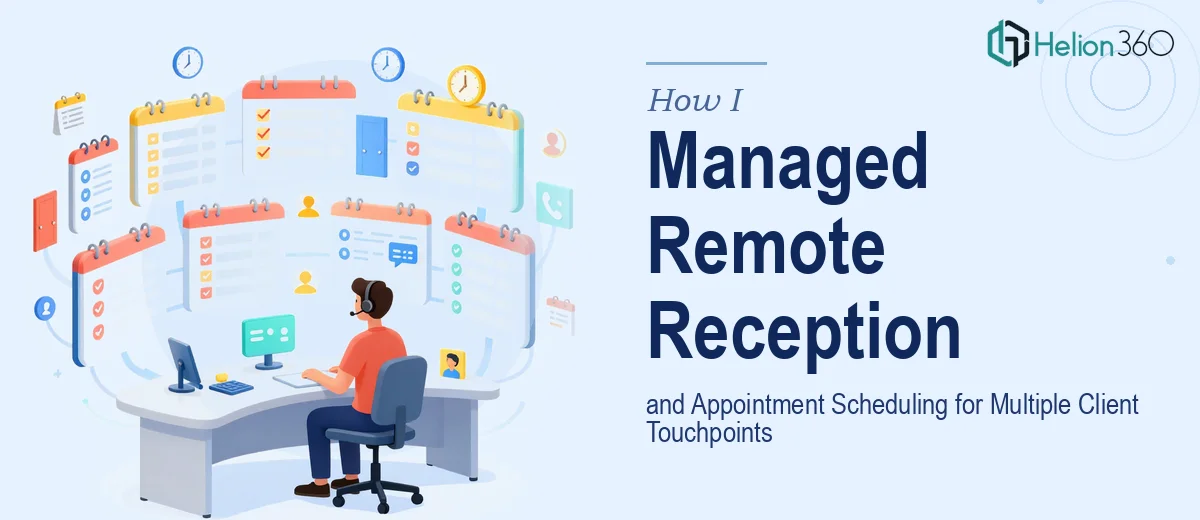
When One Person Has to Be Everywhere at Once
I took on a part-time remote role that seemed straightforward at first — handle incoming emails, answer calls, and set appointments for clients. Simple enough on paper. But within the first week, I realized that managing multiple client touchpoints simultaneously, without missing a single follow-up, was a different challenge altogether.
The volume of communication was the first thing that caught me off guard. Emails came in from different time zones. Phone inquiries needed prompt, professional responses. Appointment slots had to be coordinated without double-booking or leaving gaps that frustrated clients. And all of this had to happen consistently, even on days when bandwidth was stretched thin.
The Reality of Remote Customer Service Coordination
I started by building a basic system — a shared calendar, an email response template folder, and a simple tracker spreadsheet. For a few days, it held up. But as the client list grew and the communication volume increased, things started slipping through the cracks.
A follow-up email would go out a day late. An appointment confirmation wouldn't reach the client in time. A call would come in while I was buried in inbox management. The problem wasn't lack of effort — it was that remote reception and appointment setting at this scale requires dedicated, structured workflows that go beyond what one person can manage part-time without support.
I tried reorganizing the tracker, color-coding the calendar, and setting reminder automations. Each fix helped a little, but the underlying coordination challenge remained. There were too many moving pieces, and the risk of a dropped ball was constant.
How Helion360 Helped Bring Structure to the Process
After hitting that wall, I came across Helion360. I explained what I was dealing with — the overlapping communication channels, the appointment setting gaps, the need for a more reliable customer service workflow. Their team listened carefully and helped me think through the structure of the operation in a way I hadn't been able to on my own.
They worked with me to map out the communication flow visually, identifying where handoffs were breaking down and where the process needed cleaner documentation. What started as a chaotic inbox situation began to look like something manageable — with clear stages, defined response windows, and a logical appointment coordination sequence.
Helion360's involvement wasn't about replacing the work I was doing. It was about making the operation readable, repeatable, and scalable. Once the workflow was clearly documented and the client-facing process was tightened up, the day-to-day execution became significantly less stressful.
What Changed After Getting the Workflow Right
Once the structure was in place, the role functioned the way it was supposed to. Emails were handled within defined timeframes. Appointment confirmations went out on schedule. Client calls were routed properly, and nothing fell through because there was finally a clear system to follow.
The bigger lesson I took from this experience was that remote customer service and appointment scheduling — even in a part-time capacity — needs the same level of process design as any operations role. The "flexibility" of remote work can mask the need for rigorous coordination habits. Without that backbone, even a capable person ends up reactive instead of organized.
Professional client communication is not just about being polite and responsive. It's about having a structure that supports consistency across every touchpoint, every day, regardless of how many clients or channels are in play.
Building Something That Holds Up Over Time
The experience taught me that the gap between handling a task and handling it well at scale is almost always a systems gap. Whether you're managing one client or ten, remote reception and appointment coordination need the same things: clear documentation, defined workflows, and enough support to keep things running when complexity increases.
I'm in a much better position now than I was at the start — not because the workload got lighter, but because the operation became easier to manage through clearer process design and the right external input at the right moment.
If you're trying to keep up with remote customer service, email management, or appointment scheduling across multiple clients and finding that your current setup is starting to strain, Helion360 is worth a conversation — they helped me turn a reactive, patchwork process into something that actually works.