

Why Your Launch Page Is Doing More Work Than You Think
A product launch landing page is rarely just a placeholder. It is the first real test of whether your positioning, visual identity, and value proposition are working in unison. When someone lands on it — from an ad, a social post, or a direct link — they make a judgment in under five seconds about whether this product is worth their attention.
For software and tech products in particular, that window is even tighter. The space is competitive, the audience is skeptical, and vague messaging paired with mediocre design quietly destroys conversion before you ever get a chance to explain what the product does. Done poorly, a launch page signals that the product itself may not be ready. Done well, it creates a sense of momentum — the impression that something real is happening, and that the visitor would be missing out by not getting on board early.
The stakes compound when you add a countdown timer to the mix. Now the page is also managing expectation. Visitors form a mental contract: they expect to arrive at something on that date. That is a powerful lever, but it demands that the surrounding design and copy meet the weight of the promise.
What Getting This Right Actually Requires
Building an effective launch page with a countdown mechanic is not a single-afternoon task. The work sits at the intersection of visual design, copy strategy, interaction design, and brand consistency — and each layer has its own quality bar.
At the visual level, the design needs to do what strong brand identity work always demands: a clear typographic hierarchy, a restrained color palette, and a layout that guides the eye without overwhelming it. The call-to-action — something along the lines of "Get Started Now" or "Claim Early Access" — has to be unmissable. That means size, contrast, placement, and whitespace all working together, not competing.
At the structural level, the countdown page needs interactive elements that are actually functional under real traffic conditions. A countdown clock is useless if it breaks on mobile or resets on refresh. An early-access sign-up form needs backend handling, confirmation logic, and a thank-you state.
Brand consistency is the third requirement that people underestimate. If a logo exists and new variations are being created alongside the launch page, all three need to be treated as a system — not three separate deliverables. Inconsistencies between what appears on the landing page, the countdown page, and across marketing materials erode the professional impression before the product has had a chance to speak for itself.
How to Approach the Build, Layer by Layer
Establishing the Visual Foundation First
The right approach starts with locking down the brand layer before a single page is coded or laid out. That means finalizing the primary logo and creating variations in a vector format — SVG or AI — so that every downstream use (web, print, social) pulls from a single master file. Logo variations should not be invented freely; they should follow a deliberate system. A common structure is a primary lockup (icon + wordmark), a compact version (icon only), and a reversed version for dark backgrounds. Color variants should be drawn from the same palette, typically capped at two or three brand colors to maintain coherence.
For a real estate or fintech software product, the palette logic often leans toward one strong anchor color — deep navy, charcoal, or a bold accent — with a light neutral background and a single high-contrast CTA color. The CTA button color should appear nowhere else on the page; its visual singularity is what makes it work.
Architecting the Landing Page Layout
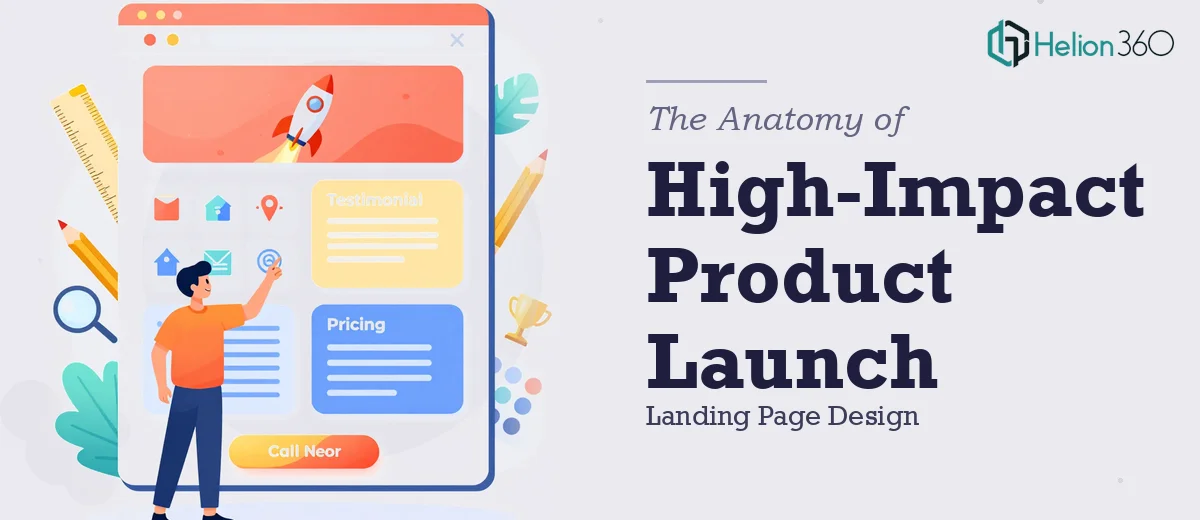
A strong product launch presentation design follows a lean architecture: hero section, value proposition block, social proof or feature highlights, and a primary CTA — in that order. The hero section carries the most weight. It needs a headline that states the benefit (not the feature), a subheadline that handles the "what it is" explanation, and the CTA above the fold.
Typography hierarchy matters more than most builders acknowledge. A readable system for this kind of page might run 56pt or 64pt for the hero headline, 22pt to 24pt for supporting body text, and 14pt to 16pt for fine print or navigation items. These are not arbitrary numbers — they correspond to legibility thresholds at common viewport widths. Compressing the hierarchy to save space almost always backfires: the eye has nothing to anchor to, and scanning becomes work.
For urgency-driven layouts, the background treatment and motion also carry meaning. A dark, high-contrast background with subtle animation or a parallax effect on a background image reads as "premium and imminent" in a way that a plain white layout does not. That atmospheric choice is deliberate brand communication.
Building the Countdown Page as a Conversion Tool
The countdown page is a distinct deliverable from the landing page, even though they share a brand system. Its job is narrower: hold attention, build anticipation, and capture early registrations. The countdown clock itself should be prominent — centered, large, and above the fold — with a DD:HH:MM:SS format that updates in real time via JavaScript. Choosing a library like Countdown.js or a lightweight custom implementation avoids the bloat of full frameworks for a single interaction.
Below the clock, an early-access sign-up module with a single email field and a clear submit label performs better than multi-field forms at this stage. The confirmation state — what happens after someone submits — is worth real design effort. A well-crafted thank-you message with a sharing prompt ("Tell a friend") can meaningfully extend reach without any additional ad spend.
A progress bar beneath the clock, showing something like "347 of 500 early access spots claimed," adds a second scarcity signal that reinforces the countdown mechanic. Even when the numbers are approximate, the visual representation of limited availability tends to accelerate sign-up decisions.
What Goes Wrong When This Work Is Rushed
The most common failure mode is treating the landing page and countdown page as separate jobs rather than as one coordinated system. When two pages are built in isolation — possibly by different people working from different briefs — they almost always drift apart in spacing, type treatment, or color usage. Visitors notice the inconsistency even when they cannot name it. The subconscious read is "this product is not fully baked."
Logo variations created without a master vector file cause compounding problems. Raster exports at the wrong resolution look sharp on one device and pixelated on another. Variations created by eyeballing the original — rather than working from structured grid guides — introduce proportion drift that becomes obvious at larger display sizes.
Another failure is underestimating mobile. More than half of launch page traffic on a typical campaign arrives on mobile devices, and a layout that was designed entirely at desktop dimensions and then compressed will almost certainly break the CTA hierarchy. The button that looked bold at 1440px wide becomes undersized and misaligned at 390px. Testing at 375px, 390px, and 430px viewport widths before launch is not optional.
Copy that leans too hard on urgency language without a substantive value statement is a subtler problem. Phrases like "Don't miss out" and "Limited time" are not inherently wrong, but they only work when there is a clear answer to "miss out on what, exactly?" The page needs to earn the urgency, not just assert it.
Finally, there is the gap between a working draft and a page that is actually ready to ship. Padding inconsistencies, misaligned elements at breakpoints, hover states that were never defined, favicon and meta image gaps — these are the finishing details that distinguish a professional launch from an amateur one. That polish work typically takes longer than builders expect.
What to Carry Forward
A product launch landing page with a countdown mechanic is a high-leverage piece of work precisely because it is the first thing a potential customer sees. The quality of the design, the coherence of the brand system, and the functionality of the interactive elements all send a signal about the product behind the page. Getting those signals right requires treating the landing page, countdown page, and logo system as a unified deliverable — not three separate tasks.
If you would rather have this handled by a team that does this work every day, Helion360 is the team I would recommend.