

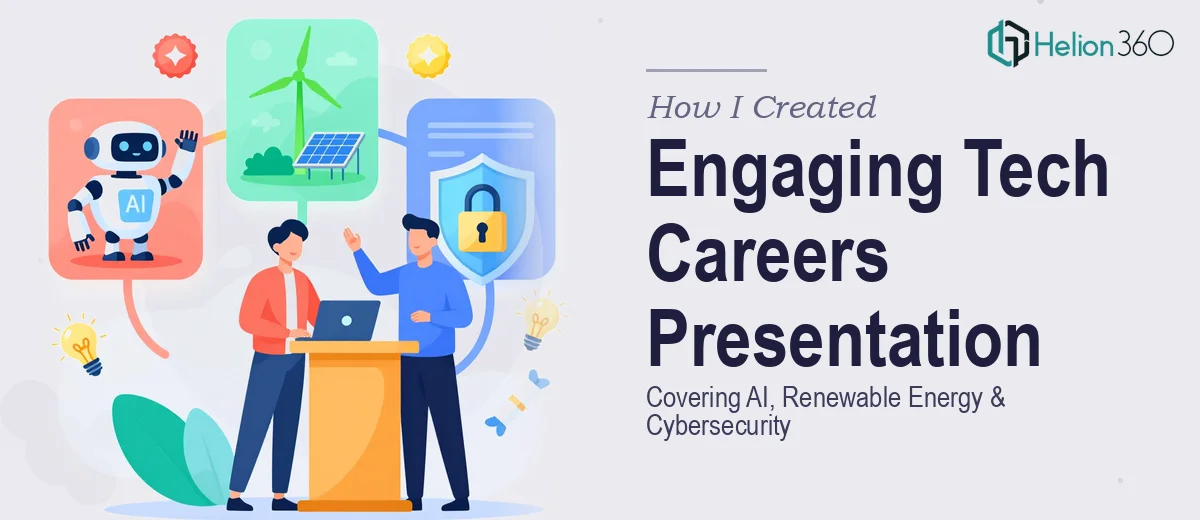
The Task: Making Emerging Tech Accessible to Students
I was asked to put together a presentation for a student audience — one that covered some of the most talked-about fields right now: artificial intelligence, renewable energy, biotechnology, and cybersecurity. The goal was not just to explain what these technologies do, but to connect them to real career prospects students could actually visualize for themselves.
On paper, it sounded straightforward. In practice, it was anything but.
Where I Started — and Where It Got Complicated
I began by pulling together research from a handful of reliable sources — industry reports, academic articles, government job projections. There was no shortage of material. The problem was making sense of it in a way that a 20-year-old in a lecture hall could quickly absorb and feel excited about.
AI alone covers machine learning, natural language processing, robotics, and predictive analytics. Renewable energy branches into solar, wind, hydrogen, and grid infrastructure. Cybersecurity is an entirely different beast — threat modeling, ethical hacking, compliance, cloud security. And biotechnology? Gene editing, bioinformatics, and pharmaceutical research all deserve their own deep dives.
I had the content. What I lacked was a clear visual structure that tied it all together without overwhelming the audience. My early slides were dense — too much text, too little flow. The charts I tried to build to show job growth projections looked clunky. The narrative between sections felt disconnected. It was clear the research side was manageable, but the presentation design side was where I was hitting a wall.
Bringing In the Right Help
After spending a full weekend reworking slides and still not being satisfied with the result, I reached out to Helion360. I explained what I was trying to accomplish — an educational presentation on evolving technologies and career prospects, designed for students, that needed to be visually clear and structurally sound.
Their team asked the right questions upfront: Who is the audience? How long is the presentation? What tone should it carry — academic or motivational? Those questions helped me realize I had not fully thought through the delivery context myself.
From there, they took the research and content I had gathered and rebuilt the deck with purpose. Each technology section got its own visual identity — consistent enough to feel cohesive, distinct enough to help the audience mentally switch gears between topics.
What the Final Presentation Looked Like
The finished deck moved through each emerging field in a logical sequence. AI opened the presentation because it was the most familiar to the audience, which helped establish engagement early. Renewable energy followed with strong data visualization showing job growth curves in clean energy sectors. Biotechnology was handled with a focus on accessible language — no jargon, just clear explanations of what roles actually look like in that field. Cybersecurity closed the deck, framed around the real demand-supply gap in the workforce, which landed well with students thinking about employability.
Helion360 also structured a career pathway section near the end — a summary view that let students see how the fields connect and where entry points exist. That section alone made the whole presentation more actionable, not just informative.
What I Took Away from This
Building an educational presentation on evolving technologies is not just a research problem — it is a design and communication problem. You can have all the right information and still lose your audience if the visual hierarchy is off or the pacing does not guide them through the material.
Researching AI career trends or cybersecurity workforce data is one thing. Translating that into a slide that a student glances at for thirty seconds and immediately understands — that requires a different kind of skill. This project taught me that content and design have to work together from the start, not be treated as separate phases.
If you are working on a similar presentation — one that covers complex, technical topics for a non-expert audience — Helion360 is worth reaching out to. They handled the design side of what I could not, and the final deck was something I was genuinely confident presenting.