

The Situation and What Was Actually at Stake
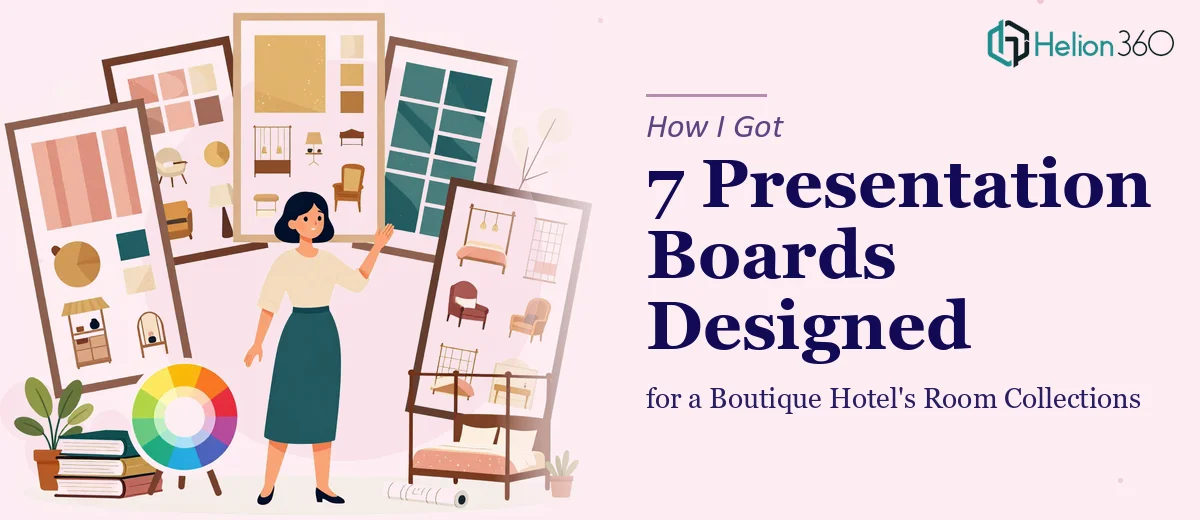
We had seven distinct room collections at our boutique hotel, each with its own aesthetic, story, and design language. The goal was a set of presentation boards that could carry these collections in front of interior partners, potential investors, and the hotel's own ownership group. These weren't internal slides — they were the first impression of rooms that hadn't been built yet.
The timeline was tight. A stakeholder review was locked in, and showing up with rough slides or inconsistent visuals wasn't an option. Each board needed to communicate a coherent visual world — the palette, the materials, the mood — while keeping the overall suite of seven boards feeling like they belonged together. I knew immediately that this wasn't something to patch together over a weekend. It needed to be done properly.
What I Found Out the Solution Actually Required
I started by looking at what professional presentation board design for hospitality actually involves. What I found made the scope real fast.
The first thing that stood out was the sheer number of decisions that have to be made per board. It isn't just dropping in room photography and a typeface. Each board needs a defined visual hierarchy, a curated palette pulled directly from the collection's identity, and a spatial layout that guides the viewer's eye through the story of the room without overwhelming them. Do that seven times with a consistent framework across all boards and the complexity stacks up quickly.
The second thing was brand coherence. All seven boards need to feel like one suite, not seven separate experiments. That requires a system — a grid, a typographic scale, a shared color logic — that holds across every board even as the individual content changes. Getting that system right from the start is the kind of work that takes real experience to execute without excessive rework.
The Work That Needs to Happen
The right approach starts with a structural audit of the content — what each room collection is actually communicating, who the audience is, and what the viewer needs to understand before they move on. For a boutique hotel context, this means mapping out seven distinct narratives and deciding how each board opens, what it emphasizes, and how it closes. Done well, this narrative scaffolding prevents the boards from becoming a visual dump of materials and photography. It forces clarity. The execution friction here is real: without that upfront structure, designers end up in revision cycles that double the project timeline.
Visual mechanics are where precision matters most. Each board requires a layout grid — typically a 12-column structure — with defined zones for hero imagery, material swatches, palette blocks, and descriptive text. Typography follows a strict hierarchy: a 36pt headline, 20pt subheads, and 13-14pt body copy, all selected to reinforce the collection's personality. Color palettes are capped at four to five tones per board, derived from the room's actual materials and carried consistently through every element. The challenge is that achieving this kind of visual precision across seven individual boards — while keeping the master system intact — requires both design expertise and serious attention to detail that is easy to underestimate.
Polish and consistency across a multi-board suite is where many attempts fall apart. Every icon, border weight, image crop, and spacing decision needs to match across all seven boards. That means master slide architecture that propagates changes cleanly, careful version control, and a final quality pass that checks every board against the system. For someone without deep PowerPoint or presentation design experience, the master slide layer alone carries a steep learning curve — and one misaligned element can unravel the sense of cohesion the entire suite depends on.
Why I Brought in Helion360 to Handle It
Looking at what proper presentation board design for a hospitality collection actually requires, I recognized quickly that attempting this myself wasn't the right move. The combination of narrative structure, visual system design, and multi-board consistency was a full-scope project — not a design touch-up.
Helion360 handled the project end-to-end and delivered fast. The work they took on covered everything: the structural narrative mapping across all seven collections, the full visual system including the layout grid, typographic hierarchy, and palette logic, and the final polish pass that made the suite feel like a single coherent body of work rather than seven separate files.
What made the engagement straightforward was that the expertise and tooling were already in place. A team that designs at this level regularly doesn't need to build the system from scratch or work through the learning curve — they bring it. The project was turned around in a fraction of the time it would have taken me to learn and execute it myself.
The Outcome and What I'd Tell Anyone in This Spot
What came back was a suite of seven presentation boards that held together as a complete visual story of the hotel's room collections. Each board had its own identity — its own palette and mood — while the suite as a whole read as one coherent piece of design work. In the stakeholder review, the boards did exactly what they needed to do: they made the collections tangible and credible before a single room was finished.
The broader lesson I took from this is that presentation board design at a professional level is not a simple formatting task. It's a discipline with real structural, visual, and consistency requirements — and when the stakes are a stakeholder review or an investor meeting, the gap between adequate and excellent is visible immediately.
If you're looking at a similar scope and want it handled end-to-end without the learning curve, Helion360 is the team to engage — they've delivered high-impact board presentations and brought exactly the depth of execution this kind of work needs.