

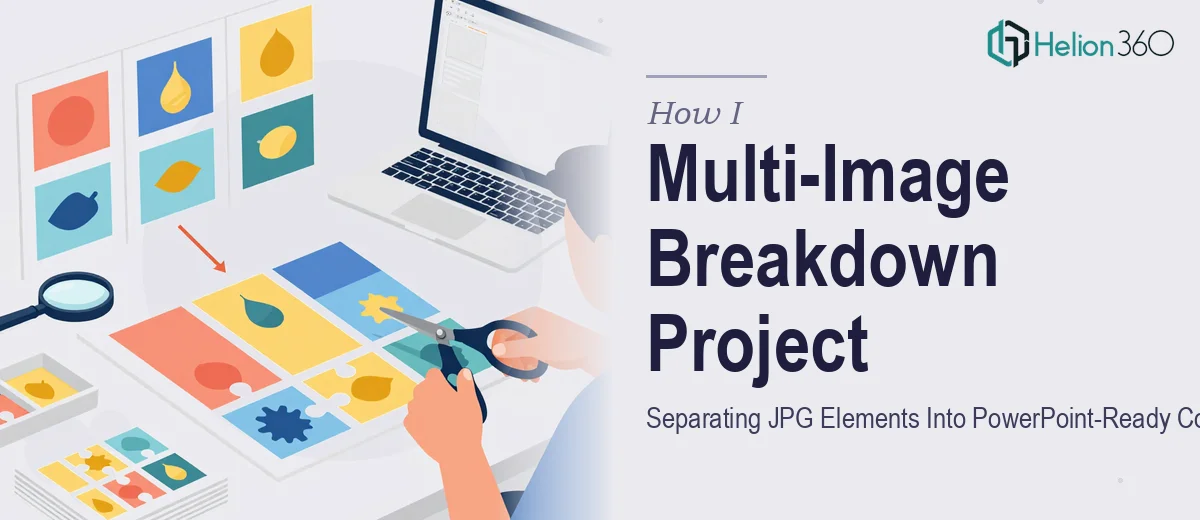
When a Simple Image Task Turned Out to Be Anything But Simple
It started with what seemed like a straightforward request. I had a set of JPG files — five images in total — and the goal was to separate the individual visual elements within each one so they could be placed independently onto PowerPoint slides. Clean edges, isolated components, no messy overlaps. Simple enough on the surface.
I had worked with images before, and I figured a few hours in Photoshop would do the job. What I did not account for was just how tightly packed and layered some of these visuals were. Background gradients blending into foreground icons, text sitting on top of illustrated elements, shadows and overlaps that made clean extraction genuinely difficult. Removing one piece without disrupting another took far longer than I expected.
Where the Process Started Breaking Down
I got through the first image with reasonable results, but the quality was inconsistent. Some edges were rough, a few cutouts had fringing artifacts, and when I dropped the elements into a test PowerPoint slide, the visual inconsistency became obvious. They did not sit cleanly against the slide background. Resizing caused pixelation because the source files were raster-based with no clean vector backup.
The problem was not just time — it was precision. Separating JPG elements into PowerPoint-ready components requires more than basic masking. You need a methodical approach: isolating each element with clean boundaries, ensuring transparency is handled properly, and delivering assets that behave predictably inside a slide layout. I was spending twice the time expected and still not getting results that matched the quality the project needed.
After two days of incremental progress and growing frustration, I accepted that this required a dedicated design workflow I was not equipped to execute at the required standard.
Bringing in the Right Support
A colleague pointed me toward Helion360. I reached out, described exactly what I was working with — five JPG files, multiple components per image, all destined for PowerPoint slides — and shared the files. Their team assessed the work quickly and came back with a clear understanding of what needed to be done.
What stood out was that they did not just take the files and disappear. They flagged a few elements upfront where the source quality would affect the final output and suggested how to handle those cases so the slide-ready assets would still look polished. That kind of communication made the handoff straightforward.
What the Finished Work Looked Like
Helion360 returned the separated elements within the agreed timeframe. Each component was cleanly isolated, exported with proper transparency, and sized appropriately for slide use. When I placed them into the PowerPoint layout, they sat exactly where they needed to — no fringing, no pixelation at standard presentation dimensions, no rework required.
The breakdown across all five images was consistent. Every element that needed to be independent was independent. The icons, the illustrated shapes, the text-adjacent visuals — all separated and usable without any further editing on my end. It was the kind of output that only comes from someone who has done this type of image extraction work repeatedly and knows where the quality traps are.
What I Took Away From This Project
Breaking apart JPG elements for PowerPoint use sounds like a minor task until you are actually inside it. The challenge is not just cutting things out — it is doing so in a way that holds up inside a presentation environment. Raster images do not behave like vector graphics, and the margin for error on visual quality is narrower than most people expect when they first look at the files.
I also learned that recognizing when a task needs specialist execution is not a failure of capability. The project got done faster, the result was cleaner, and I did not spend three more days fighting with masking tools trying to get there myself.
If you are facing the same kind of image extraction work — especially where multiple JPG elements need to be separated cleanly for use in PowerPoint slides — Helion360 is worth reaching out to. They handled the complexity efficiently and delivered exactly what the project required.